

Because The True Digital Value of Music Assets Depends on Provenance, Permanence, and Structure - Not Just an Audio File.
Fundamental Shift: From Files to Assets
Music digital distribution requires a shift beyond flat audio files to session- container-based digital assets.
This shift is not aesthetic or optional; it is driven by:
-
long-term value beyond a single release
-
playback that adapts instead of staying fixed
-
distribution models that no longer assume a final render
-
automation that exposes what files leave behind
What Changes at the Point of Distribution
In traditional systems, distribution packaging begins when a stereo WAV/AIFF is exported.
In asset-native systems, distribution packaging begins when a session-derived object is prepared.
This changes what can be:
-
Measured (what actually shaped the sound)
-
Attributed (who and what contributed)
-
Preserved (how the track was built, not just how it sounds)
-
Valued beyond a single render or format
Audio Files Were Designed for Digital Playback, Not Digital Assets
Audio files faithfully preserve sound, but they were designed for a world where distribution was protected by the playback medium. Vinyl, tape, and CDs imposed cost, friction, and control through physical constraints. Digital files removed those constraints without replacing the structural protections they provided.
Modern music production evolved inside systems-rich, session-based digital environments. Distribution did not.
As a result:
-
Creative and technical labor embedded upstream becomes invisible downstream
-
Attribution, context, and economic participation are reconstructed informally, if at all.
DAAP introduces the missing structural layer. Not to replace audio formats or playback systems, but to define recorded music as a durable digital asset rather than a transient audio file.

Music's Necessary Architectural Mode
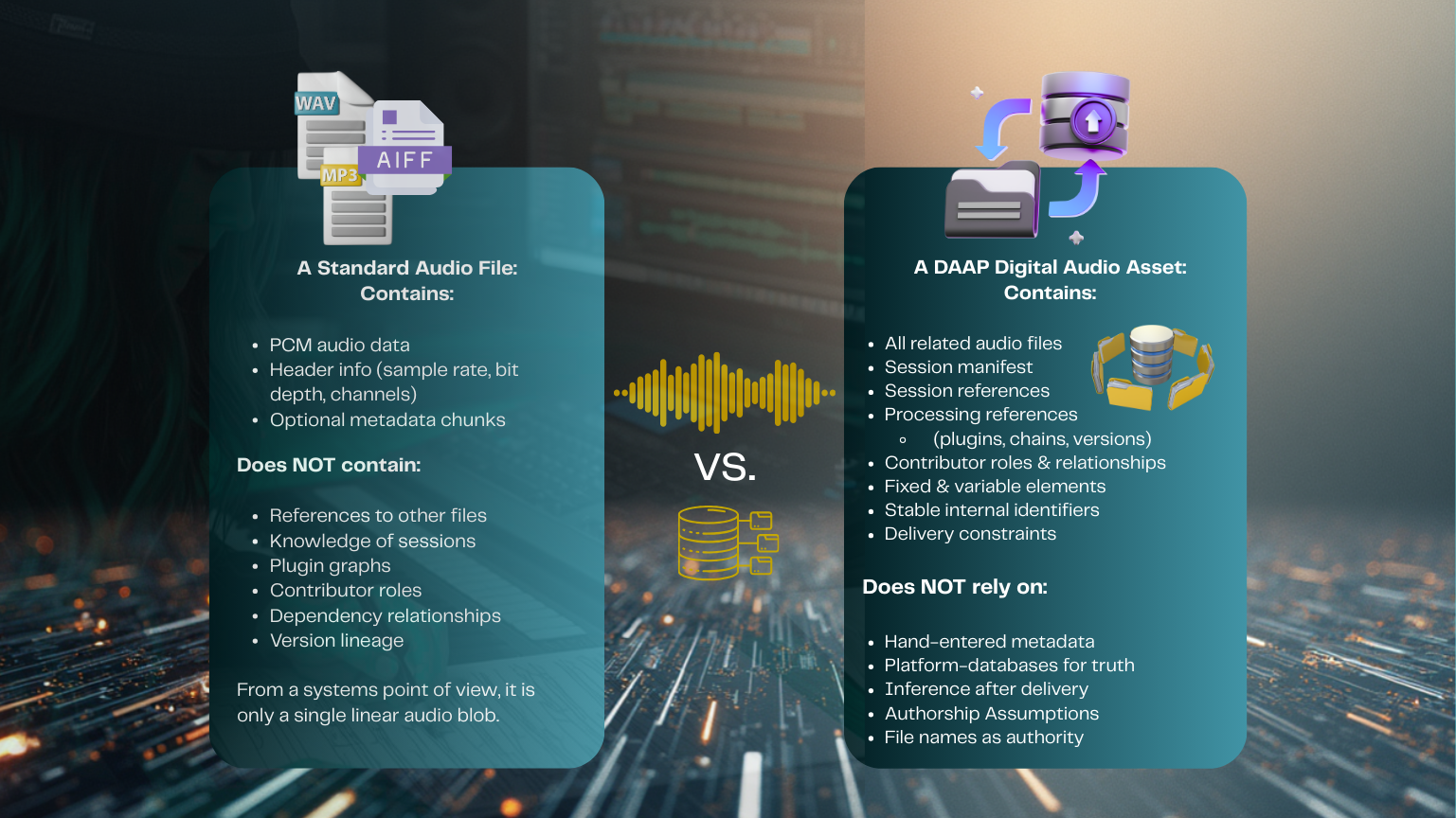
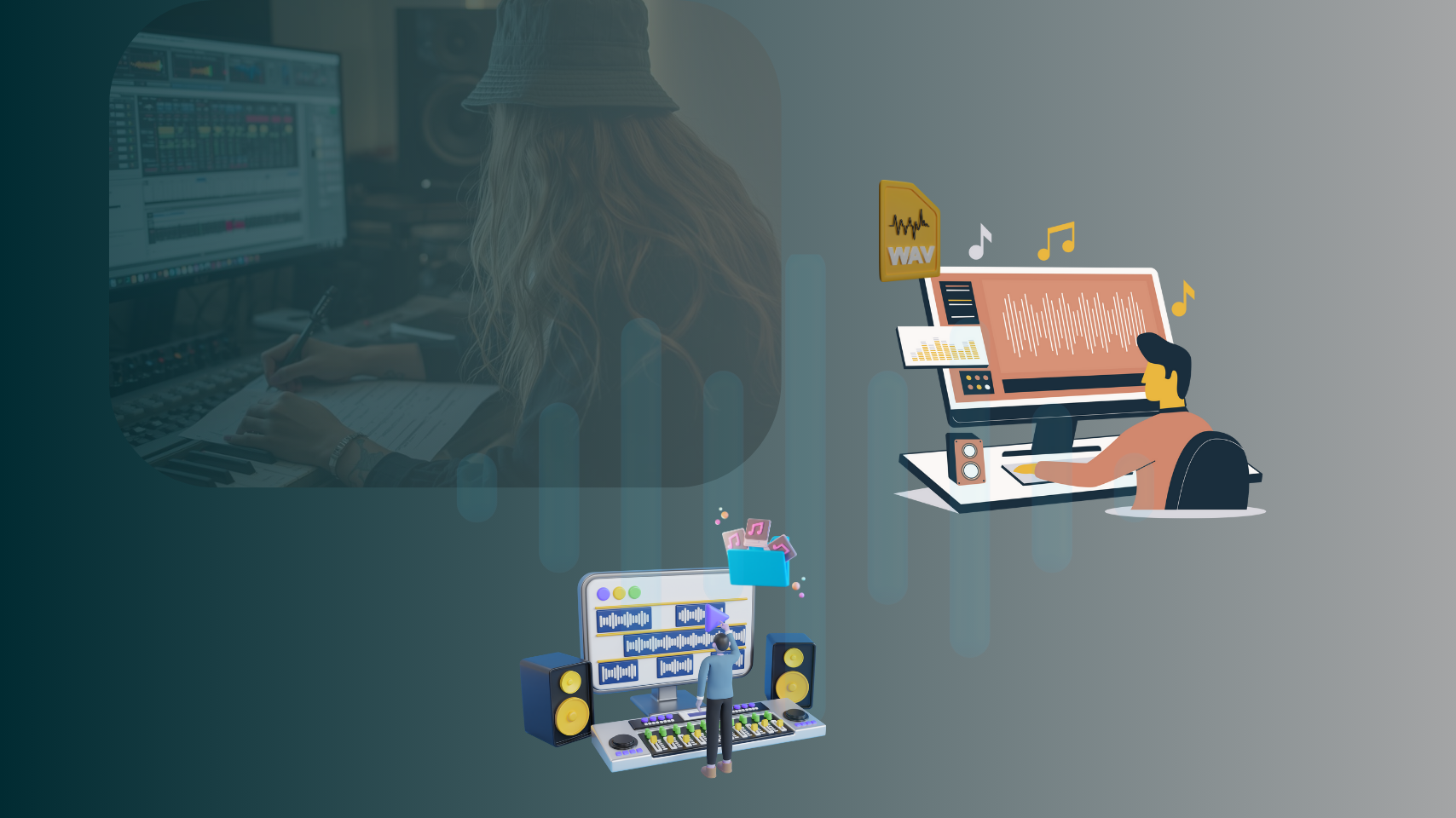
DAAP defines digital audio as an asset‑level topology, not a file format. It treats a musical work as a structured, session‑derived container whose identity, attribution, and provenance are established at the moment of asset formation. In this model, the work is not reduced to a flattened audio file; it is preserved as a composite digital object with internal structure, context, and verifiable authorship.
Upstream, And Downstream
DAAP preserves the work as a composite digital object upstream so that this structured can enable environments to recognize, respect, and build upon the full creative and technical contributions involved in the work, including tool‑level participation downstream.
This is not a market position or a business model. It is a topological distinction:
-
Distribution systems handle files.
-
DAAP defines the asset that precedes those files.
-
The asset’s structure, attribution, and consent context can be fixed into any rendering into audio‑only derivatives.


When Attribution Survives Distribution, Value Can Too
In the studio, everyone understands that a recording is built from contributions. The artist writes and performs the song. The producer shapes the direction. The engineer builds the signal path. Today, an entire ecosystem of digital tools contributes to the final result: from signal processing emulators to synth engines to sample libraries, beat packs, and increasingly AI-assisted elements such as voice models or background instrumentation generators, shape the final sound.

The Export Problem
For decades, the industry has treated the exported audio file as the finished product.
That made sense when the production environment and the playback environment were completely separate. The signal path lived inside the studio. The consumer only received the result.
But digital production changed that equation. These tools contribute directly to the sound of the record. Yet once the audio file leaves the session, the digital distribution system has not yet evolved standards to recognize and attribute that contribution.
The current distribution system only knows the flat waveform attached to scattered metadata.

The Digital Ingredients
A record is more than its waveform. Producers know that two tracks with the same arrangement can sound completely different depending on the tools used and the signal path that shaped them. Those choices are not cosmetic, but the current digital distribution model treats digital production tools as if they never existed.
Think about a loaf of bread.
Every loaf contains ingredients: flour, salt, yeast, water. Those ingredients are accounted for in the cost of every unit. Digital distribution for music works in a similar way.
A finished recording contains ingredients too: performances, production decisions, signal processing, instruments, sonic tools.
But when music is delivered as a flat audio file, the ingredient list disappears.

The Missing Capability
Once the recording signal path collapses into a waveform, the digital distribution system does not currently provide a way to recognize all of the ingredients used to create the sound.
When music is distributed as a structured asset rather than just an audio file, the system gains the ability to preserve the relationships that existed in the session about:
-
who contributed
-
what tools shaped the sound
-
which elements are authoritative
-
what participation rules exist
This does not force new economic models or public exposure to any proprietary signal process (aka secret sauce). It simply creates the technical foundation for future downstream functionality and potential economic participation.

The Market Still Decides
The music industry is well into a period where digital tools are responsible for more of the sound than ever before.
Some releases will always remain simple audio files. Others may choose to participate in asset-based distribution. The difference is that the industry finally has the option to support attribution and participation for the upstream creative process, something that was impossible when music could only be delivered as a waveform.
The question is no longer whether these tools matter. The question is whether the digital distribution system is finally ready to recognize their role.
That is the infrastructure conversation that the Digital Audio Assets Protocol is designed to begin.

Before Tools, There's Shared Understanding
DAAP is not a product you install first.
It’s an architectural shift that only works if the industry aligns on the problem it’s solving.
Before utilities, standards need language. Before infrastructure, assumptions need to be examined.
That’s why this process starts here.
Step 1:
Take the Survey
The survey is not market research. There are no right or wrong answers.
It exists to surface how creators, toolmakers, and platforms currently understand:
-
audio files as delivery objects
-
attribution and visibility
-
value creation in digital music
-
AI, indistinguishability, and context loss
-
infrastructure limits in modern distribution
Your responses help establish a shared baseline before standards harden.
Start with the survey.

Step 2:
Read the White Paper
The DAAP white paper lays out the full architectural rationale.
It explains:
-
why audio files were designed for playback, not distribution protection
-
how provenance, structure, and permanence operate at the asset level
-
where existing systems break down, and why
-
how DAAP fits alongside current platforms without replacing them
This is not marketing material.
It is a technical and conceptual foundation intended for careful reading.

Step 3:
Join the Consortium
The DAAP Consortium is a neutral, standards-focused group
it exists to:
- define asset-level norms before fragmentation sets in
- align creators, toolmakers, and platforms on shared realities
- document emerging practices around provenance, structure, and permanence
If these questions matter to you, this is where the conversation continues.
Information
Contact us
Get in touch with us today to discuss your music information system needs.
Location
Nquist.net
Silicon Beach, California, United States
