

Download the DAAP Development Modules
The Digital Audio Assets Protocol (DAAP) is implemented as a structured, multi-stage workflow that reflects how music should ideally be exported, validated, and prepared for distribution.

Three-Stage Digital Audio Assets Packaging Preparation
DAAP is composed of three distinct modules, each representing a critical phase in the transition from a working studio session to a fully defined digital asset. These modules are made available individually to support flexible integration, technical evaluation, and staged adoption across different environments.
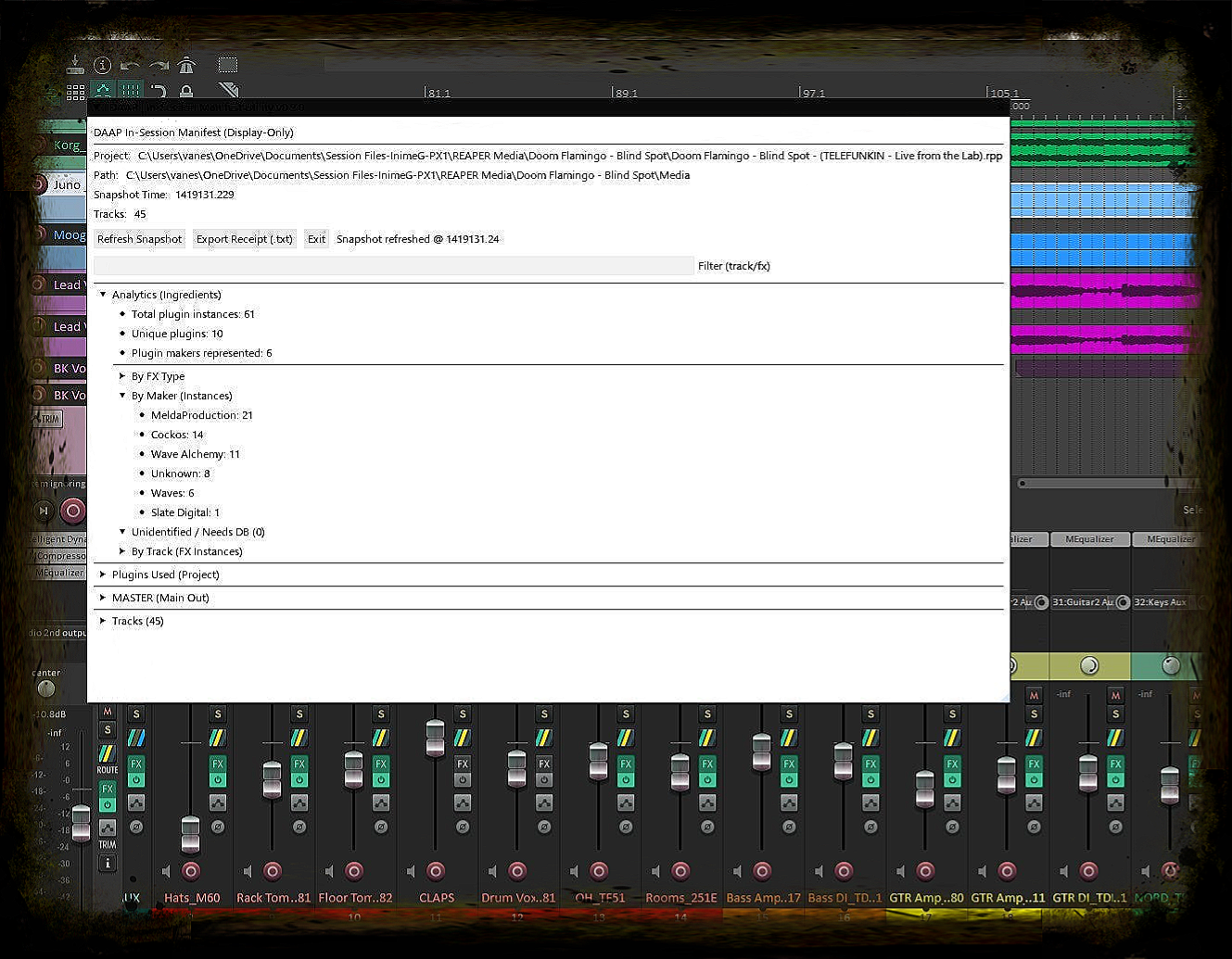
In-Session Manifest Utility
Operates inside the DAW to capture and represent the active session as a structured, inspectable system.
Features
- Real-time session inspection (tracks, routing, topology)
- Plugin chain identification (VST3/AU/CLAP support)
- Parameter state capture at snapshot
- Track-to-plugin relationship mapping
- Session structure visualization (hierarchy + dependencies)
- Non-destructive operation within the DAW environment
- Export of structured manifest data (JSON-based schema)
- Foundation layer for downstream asset format

Package Preparation Utility
Validates and organizes project assets at the filesystem level prior to packaging.
Features
- Project folder scanning and asset discovery
- File integrity checks (missing, duplicate, orphaned media)
- Session-to-disk reconciliation (reference vs actual files)
- Standardized directory structuring
- Pre-packaging validation reports
- Manifest refinement based on physical assets
- No alteration of original session or media files
- Preparation layer for canonical asset binding

Package Authority Integration
Binds validated assets into a DAAP-compliant package with a canonical manifest and integrity model.
Features
- Canonical manifest generation (authoritative asset definition)
- Audio payload binding (master, stems, alternates)
- Integrity structure creation (hashing / verification layers)
- Asset identity assignment (stable identifiers)
- Provenance and attribution embedding
- Packaging into a portable asset container
- Output ready for distribution and playback environments
- Compatibility with asset-aware player systems
Documentation & Repositories
This is where your journey begins. Get to know and understand what this process does, and how we're committed to quality and great service. Join us as we grow and succeed together. We're glad you're here to be a part of the story.


3-Part Module Manual
Each DAAP module is accompanied by a technical manual that outlines its intended use, operational context, and role within the broader asset formation workflow. The documentation provides step-by-step guidance on installation, configuration, and execution, along with explanations of system behavior, expected inputs and outputs, and integration considerations. These manuals are designed to support engineers, developers, and technical evaluators in understanding how each stage functions independently and as part of the complete DAAP process, ensuring clarity and consistency across different environments.
Source Code Repositories
Each module is supported by a dedicated source repository containing the reference implementation, version history, and supporting development materials. The repositories provide access to the codebase, update tracking, and any relevant dependencies required for building, testing, or extending the utilities. While the implementations are made available under open-source licensing, their use and integration are governed by the applicable license terms and aligned with the protocol’s architectural intent. These repositories serve as the foundation for technical evaluation, collaboration, and future development within the DAAP framework.
